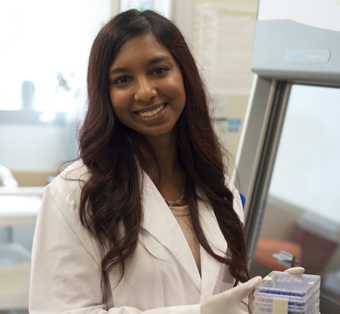
PhD student Dessi Loukov in the lab of Dr. Dawn Bowdish, recently published a study showing that splenomegaly in old mice is a result of extramedullary hematopoiesis, and that this increased monopoiesis is driven by age-associated increase in TNF. The study compared changes in the microarchitecture and composition of the spleen in old and young mice and found that in old mice, there was an increase in the size and cellularity of the red pulp (the site of hematopoiesis of myeloid precursors). To study the role of TNF in the development of extramedullary hematopoiesis, they used TNF KO mice and found that these mice did not have increased extramedullary monopoiesis. Furthermore, they demonstrated that increased splenic myelopoiesis was a result of the aging microenvironment. This work suggests that strategies which aim to decrease the inflammatory microenvironment that comes with aging, would be effective in reducing inflammatory diseases propagated by cells of the myeloid lineage. Read More
Macrophages play a critical role in innate immunity by detecting, engulfing and destroying pathogenic bacteria and alerting neighbouring immune cells to join the fight against infection. They have many different receptors on their cell surface that allow them to carry out these important processes. A particular group of receptors called Scavenger Receptors are vital to this response. A recent study published in Immunology and Cell Biology by PhD student Kyle Novakowski from the laboratory of Dr. Dawn Bowdish has uncovered a mechanism by which a specific scavenger receptor contributes to macrophage-specific antibacterial immunity.
Scavenger Receptors are evolutionarily ancient and have evolved to recognize a wide array of pathogens by detecting ligands that are common across many pathogenic organisms. A particularly important Scavenger Receptor is Macrophage Receptor with Collagenous Structure, or MARCO. MARCO has been shown to significantly contribute to the clearance of Streptococcus pneumoniae colonization of the nose and in models of pneumococcal pneumonia. The NSERC-funded study took a unique approach to functionally characterizing how MARCO contributes to innate immunity by studying a naturally-occurring variant of the receptor. The study highlighted the importance of a particular domain of the receptor that is required for macrophages to bind and internalize ligands. The study also showed that the domain is necessary to enhance the pro-inflammatory response to pathogenic Streptococcus pneumoniae and can enhance cellular adhesion; both vital to proper macrophage functions.
The Bowdish lab is thrilled to participate in NSERC’s “Science, Action!” video contest. An undergraduate team of videographers (Yung Lee, Karanbir Brar, and Tony Chen) filmed our lab discussing our NSERC funded work on discovering the evolutionary origins of phagocytosis. Please “like” and share our video to help us move on to the next level of the competition.
Our NSERC funding has been integral to the lab. This was one of the first grants that got the lab up and running and to date we have had 5 NSERC funded graduate students and 10 undergraduate students including 3 NSERC Undergraduate Summer Research Assistants in the lab. This funding has also been instrumental in developing new techniques, technologies and collaborations that have extended our research capacity.
What are we studying with our NSERC funded research?
Our NSERC Discovery Grant entitled “Uncovering mechanisms of phagocytosis by class A scavenger receptors” allows us to use bioinformatics and molecular biology to understand the very origins of immunity.
Our lab studies macrophages, which are sentinel cells of the innate immune response. They patrol the body and engulf damaged tissues or pathogens and destroy them. This Pac-man like ability to eat microbes is called “phagocytosis”. We study a particular class of receptors that macrophages use to phagocytose called the scavenger receptors.
Phagocytosis is an ancient process that is central to defence and nutrient acquisition in single-celled organisms and embryonic development, clearance of modified host proteins and innate immunity in multi-cellular organisms. During phagocytosis a phenomenal amount of information is transmitted to the cell including the size and shape of the particle, its composition, and potential toxicity. How this information is transmitted is not really understood but is the focus of our work.
All the major discoveries in immunology (e.g. toll like receptors, intracellular sensors, signalling pathways) began with studies in comparative or evolutionary biology and my program of research continues this tradition. Indeed, the process of phagocytosis is believed to be the prototype function of the immune system as acquisition of nutrients developed into a mechanism of self- versus non-self recognition. The process of uptake is so ancient that it must have occurred prior to or in conjunction with the expression of protein receptors on the surface of the cell. The scavenger receptors, being primitive but effective uptake receptors may rely on membrane dynamics and lipid interactions more than their more evolutionarily recent counterparts (e.g. Fc receptors). We use bioinformatics to study the genomes of ancient and modern animals to study how the scavenger receptors change over time. Parts of the scavenger receptor gene or protein that haven’t changed over time, are likely very important for function. We use molecular biology to uncover how these particular regions of the protein work. Studying these processes will uncover novel mechanisms of signalling and contribute to our understanding of the cell biology of endocytosis and phagocytosis, which are processes integral to embryonic development, immunity, homeostasis, implant recognition and adhesion and consequently essential to many fields of biology.
Check out the other videos of the “Science, Action!” video contest here.
As mentioned in an earlier post, Bowdish lab PhD student, Avee Naidoo, won the Fall 2014 CIHR Institute of Aging Anne Martin-Matthews Doctoral Research Prize of Excellence in Research on Aging and is mentioned in the CIHR’s Institute of Aging newsletter!
Avee Naidoo successfully passed her transfer exam today. She now joins the ranks of Fan Fei, Mike Dorrington, Kyle Novakowski, Dessi Loukov, Sara Makaremi, and Pat Schenck as part of the Bowdish lab PhD posse. Well done Avee!
Becoming a PhD student in the Bowdish lab is a family affair. Junior lab members sent their favourite stuffie in to wish Avee luck. It must have worked as she aced it!
…and a little lab humour. We have both skilled scientists (see picture at bottom) and skilled artists (see whiteboard) in our lab.
Alex Jiang underwent the CaRMs residency matching processwas able to land his top choice residency in Urology at Western. This is an exciting addition all the successes he has had in medical school at Western. Well done Alex!
Bowdish lab trainees Avee Naidoo and Netusha Thevaranjan were recognized for their research excellence at the fourth annual Michael G. DeGroote Institute for Infectious Disease Research (IIDR) Trainee Research Day. The event was held at CIBC Hall on Friday, October 10th and featured a keynote address by Professor Quim Madrenas of the Department of Microbiology and Immunology at McGill University. In addition to the keynote speach, the talented trainees at IIDR presented their latest research findings and accomplishments during the day.
A second-year Master’s student Avee Naidoo was awarded with the Michael Kamin Hart Memorial Scholarship at a reception held at the University Club at the end of the day. The $1,800 scholarphip is named in honour of a gifted Master’s student of IIDR who tragically passed away in 2011. Avee plans to use the scholarship to attend a Keystone meeting on inflammation and aging in Montreal next year. Another Master’s student in the Bowdish lab, Netusha Thevaranjan, was awarded with the IIDR Awards of Excellence for her poster presentation. Kyle Novakowski was the runner up for the PhD poster award.
Both Avee and Netusha are currently working to elucidate the mechanisms underlying age-associated deterioration of the innate immune response.
Congratulations to both Avee and Netusha!
Netusha Thevarnjan wins best MSc poster presentation and Avee Naidoo wins the Michael Kamin Hart Memorial scholarship at the 2014 IIDR trainee day. Dawn beams with pride.