Why humans are uniquely sensitive to wildfire smoke – YouTube Explainer with Dr. Bowdish

Dr. Dawn Bowdish describes how the lab’s NSERC funded research uncovered a link between mutations that protect humans against tuberculosis but leave us susceptible to particulate air pollution.

Read the story here.

Based on the research below:

Bowdish DM, Sakamoto K, Lack NA, Hill PC, Sirugo G, Newport MJ, Gordon S, Hill AV, Vannberg FO. Genetic variants of MARCO are associated with susceptibility to pulmonary tuberculosis in a Gambian population. BMC Med Genet. 2013 Apr 23;14:47. doi: 10.1186/1471-2350-14-47. PMID: 23617307; PMCID: PMC3652798.

Novakowski KE, Huynh A, Han S, Dorrington MG, Yin C, Tu Z, Pelka P, Whyte P, Guarné A, Sakamoto K, Bowdish DM. A naturally occurring transcript variant of MARCO reveals the SRCR domain is critical for function. Immunol Cell Biol. 2016 Aug;94(7):646-55. doi: 10.1038/icb.2016.20. Epub 2016 Feb 18. PMID: 26888252; PMCID: PMC4980223.

Novakowski KE, Yap NVL, Yin C, Sakamoto K, Heit B, Golding GB, Bowdish DME. Human-Specific Mutations and Positively Selected Sites in MARCO Confer Functional Changes. Mol Biol Evol. 2018 Feb 1;35(2):440-450. doi: 10.1093/molbev/msx298. PMID: 29165618; PMCID: PMC5850514.

Also featured in the New York Times “Air Pollution, Evolution and The Fate of Billions of Humans” by Carl Zimmer

https://www.nytimes.com/2020/01/13/science/air-pollution-fires-genes.html

Publication: Chronic TNF in the aging microenvironment exacerbates Tet2 lost-of-function myeloid expansion

Download PDF here.

Link to journal here.

Abstract: Somatic mutations in the TET2 gene occur more frequently with age, imparting an intrinsic hematopoietic stem cells (HSCs) advantage and contributing to a phenomenon termed clonal hematopoiesis of indeterminate potential (CHIP). Individuals with TET2-mutant CHIP have a higher risk of developing myeloid neoplasms and other aging-related conditions. Despite its role in unhealthy aging, the extrinsic mechanisms driving TET2-mutant CHIP clonal expansion remain unclear. We previously showed an environment containing tumor necrosis factor (TNF) favors TET2-mutant HSC expansion in vitro. We therefore postulated that age-related increases in TNF also provide an advantage to HSCs with TET2 mutations in vivo. To test this hypothesis, we generated mixed bone marrow chimeric mice of old wild-type (WT) and TNF–/– genotypes reconstituted with WT CD45.1+ and Tet2–/– CD45.2+ HSCs. We show that age-associated increases in TNF dramatically increased the expansion
of Tet2–/– cells in old WT recipient mice, with strong skewing toward the myeloid lineage. This aberrant myelomonocytic advantage was mitigated in old TNF–/– recipient mice, suggesting that TNF signaling is essential for the expansion Tet2-mutant myeloid clones. Examination of human patients with rheumatoid arthritis with clonal hematopoiesis revealed that hematopoietic cells carrying certain mutations, including in TET2, may be sensitive to reduced TNF bioactivity following blockade with adalimumab. This suggests that targeting TNF may reduce the burden of some forms of CHIP. To our knowledge, this is the first evidence to demonstrate that TNF has a causal role in driving TET2-mutant CHIP in vivo. These findings highlight TNF as a candidate therapeutic target to control TET2-mutant CHIP.

Bluesky explainer thread here:
New Paper Alert: “Chronic TNF in the aging microenvironment exacerbates Tet2 lost-of-function myeloid expansion” published in Blood Advances #ImmunoSky #CHIP https://authors.elsevier.com/sd/article/S2473952924003860 (1/n)

Over time the progenitor cells (#stemcells) in our bone marrow acquire random mutations, with some genes being more likely to acquire these mutations than other. The Tet2 gene is one that acquires mutations. This is a problem because it regulates other genes through methylation (2/n)

Hematopoetic #stemcells with Tet2 mutations favour production of myeloid cells (#neutrophils #monocytes) over lymphoid cells (#Tcells #Bcells) and can outcompete stem cells that don’t have Tet2 mutations.(3/n)

If too many white blood cells originate from these mutants it is called Clonal Hematopoesis of Indeterminate Potential or #CHIP. CHIP is associated with an increase in mortality, and pneumonia (see prev paper), because immune cells with these mutations don’t work as well (4/n) https://shorturl.at/JNk6d

With age the proportion of Tet2 mutant cells increases and it is thought that the increased #inflammation that occurs with age contributes. Darwinian evolution happens in the bone marrow and stem cells with Tet2 mutations can outcompete (i.e. replicate more, make more white blood cells) than those without (5/n)

We investigated whether Tet2 mutant stem cells could outcompete others in the presence of the inflammatory cytokine TNF, which increases with age. We put a mix of normal and Tet2-/- stem cells into old mice that had lots of TNF and those with none (TNF KO). 6/n

Stem cells with Tet2 mutations could outcompete normal cells in old mice that had lots of TNF but not in TNF knockout mice. The aging inflammatory microenvironment contributes to CHIP! (7/n)

Cool finding- People with newly diagnosed #rheumatoidarthritis have lots of TNF and had low level of Tet2 and other CHIP mutants that went down as they started anti-TNF or anti-inflammatory therapy! Proof this happens in humans too (8/n)

Huge thank you to not on Bluesky Drs Michael Rauh (Queens), Candice Quin ( @uniofaberdeen.bsky.social ), Maggie Larche (UCalgary), Salman Basrai&Sagi Abelson @oicr.bsky.social and team. (9/9)

Dr. Jessica Breznik talks about her research in the American Journal of Physiology-Gastrointestinal and Liver Physiology Podcast

In this podcast first author Dr. Jessica A. Breznik of McMaster University, discusses the recently published manuscript titled “Diet-induced obesity alters intestinal monocyte-derived and tissue-resident macrophages and increases intestinal permeability in female mice independent of tumor necrosis factor.” 

NEW & NOTEWORTHY We found that diet-induced obesity in female mice has tissue- and time-dependent effects on intestinal paracellular permeability as well as monocyte-derived and tissue-resident macrophage numbers, surface marker phenotype, and intracellular production of the cytokines IL-10 and TNF. These changes were not mediated by TNF.

Article Citation: Diet-induced obesity alters intestinal monocyte-derived and tissue-resident macrophages and increases intestinal permeability in female mice independent of tumor necrosis factorJessica A. Breznik, Jennifer Jury, Elena F. Verdú, Deborah M. Sloboda, and Dawn M. E. Bowdish

American Journal of Physiology-Gastrointestinal and Liver Physiology 2023 324:4, G305-G321

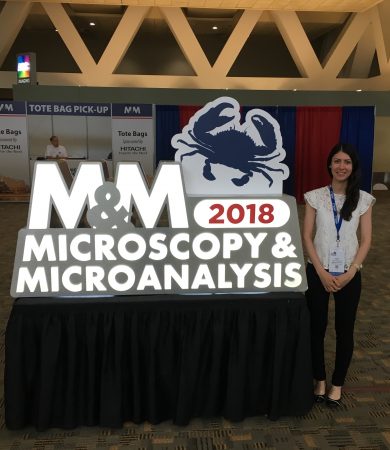
Congratulations to Sara Makaremi (PhD candidate) for winning the Gerald T Simon Award for her microscopy!

Congratulations Sara for winning the Gerald T Simons award for her presentation at the Microscopical Society of Canada and Microscopical Society of America (M&M2018) in Baltimore.

To read her award winning abstract, click here.


Congratulations to Dessi Loukov on successfully defending her PhD!

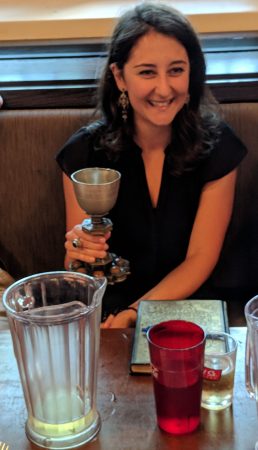
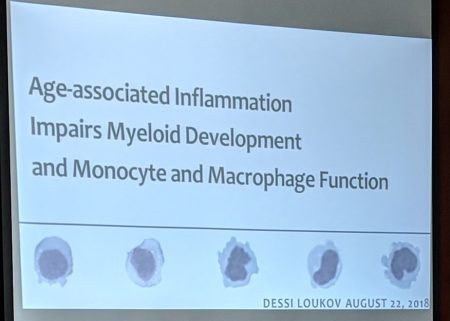
Congratulations to the newly minted Dr. Loukov on successfully defending her thesis entitled “Age-Associated Inflammation impairs Myeloid Development and Monocyte & Macrophage Function”!

The newly minted Dr. Loukov drinks from the chalice.

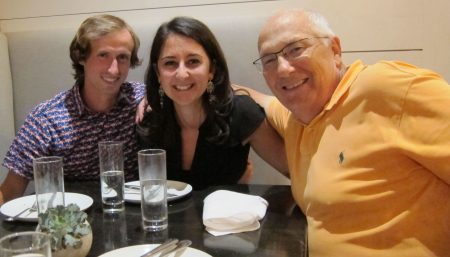
Dessi celebrates her thesis defence with one of her mentors Dr. Mark McDermott.

Two doctors.

Congrats to high school student Anika Gupta as she heads off to the international science fair!

The Bowdish lab was very proud to host Anika Gupta, a high school student, for her Bay Area Science and Engineering Fair (BASEF) project.

Her project was entitled “Quantifying Lung Macrophages to Understand Increased Susceptibility to Bacterial Pneumonia with Age.”

Anita won the Dr. Doyle Biology Award for the best Biology project, a Gold merit award as well as the Pinnacle Award for the Third Best in Fair and a sponsored Trip Award to compete in the Intel International Science and Engineering Fair in Pittsburgh, Pennsylvania in May!

Way to go Anika!

Anika Gupta receiving the third place “ArcelorMittal Dofasco Pinnacle Best-in-Fair” award.

See her featured in the Hamilton news here.

Dr. Bowdish gives a lecture for kids “Who’s got more cooties – boys or girls?”

Dr. Bowdish explains what cooties are, how the microbes that live on and in us can be friends and foes and describes how differences in infections and health between boys and girls, men and women are sometimes due to biology and sometimes due to behaviour.

Read the article summarizing the event here.

To see Dr. Bowdish put on a macrophage cape and teach the school kids the difference between a commensal, a pathobiont and a pathogen by dressing up their teachers, watch here…..

Children wrote down questions they had during the lecture and got answers back to them the next day. Had to break out the dictionary to find the etiology of the word “cooties”.

Kyle Novakowski is the Bowdish lab’s newest PhD!

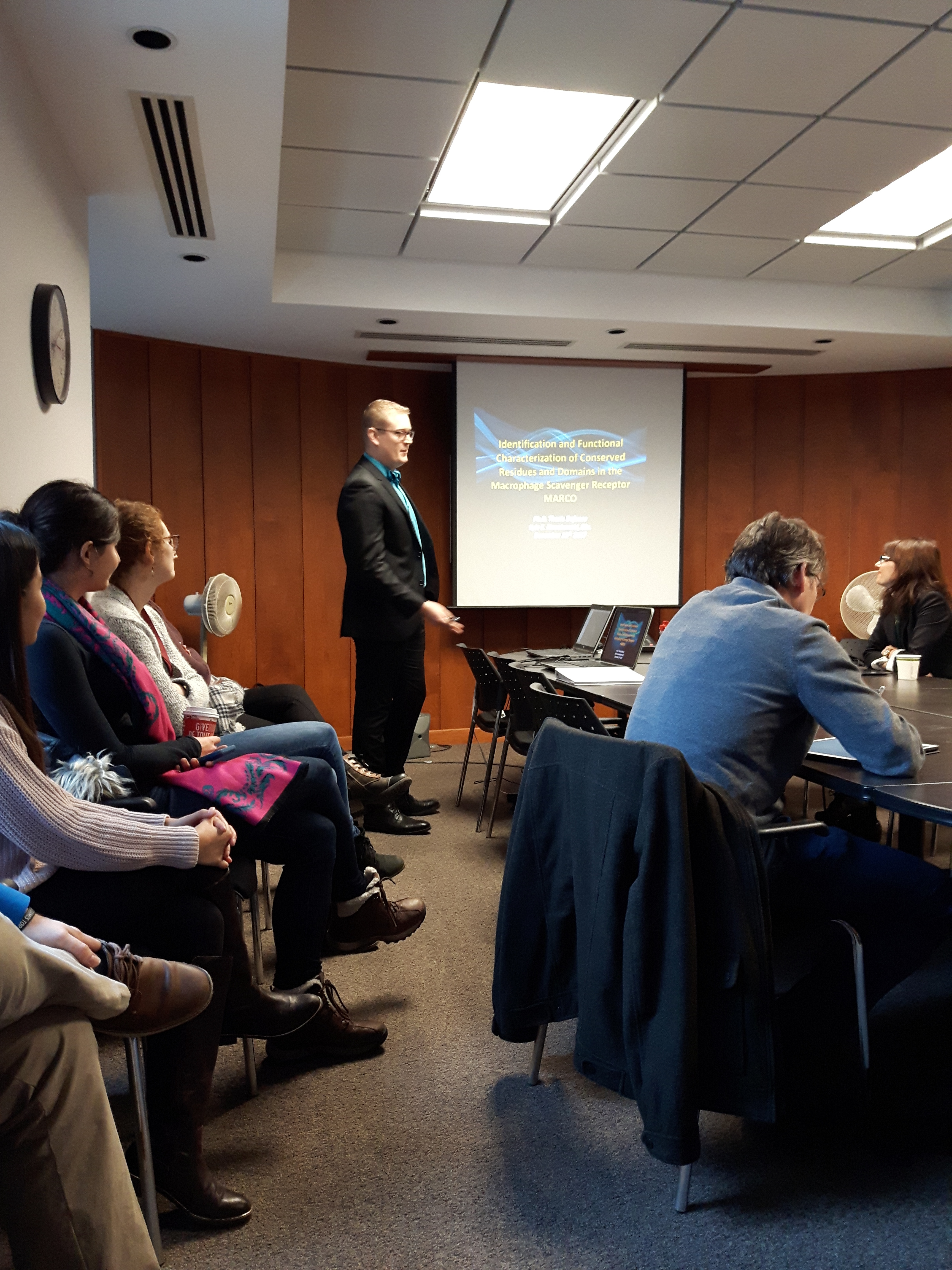
Kyle Novakowski successfully defended his thesis “IDENTIFICATION AND  FUNCTIONAL CHARACTERIZATION OF CONSERVED RESIDUES AND DOMAINS IN THE MACROPHAGE SCAVENGER RECEPTOR MARCO”  to become the Bowdish lab’s 4th PhD student. He’ll be joining Turnstone Biologics as a PhD scientist. We wish him very well in his future endeavours. Congratulations Dr. Novakowski!