
New Publication: “Assessing SARS-CoV-2 immune markers in vaccinated asymptomatic adults after household exposure in Canada (AB-PROTECT): a prospective cohort study” in Lancet Microbe

See the publication here: https://www.thelancet.com/journals/lanmic/article/PIIS2666-5247(26)00155-2/fulltext

And read about the findings here….

New Publication alert (and this one has got some immunologic hidden gems!) – "Assessing SARS-CoV-2 immune markers in vaccinated asymptomatic adults after household exposure in Canada (AB-PROTECT): a prospective cohort study" By Drs J. Breznik & C Kandel & team @lancetmicrobe.bsky.social 1/n

— Dr. Dawn Bowdish (@msmacrophage.bsky.social) 2026-09-16T12:54:00.075Z

or…

New Publication alert (and this one has got some immunologic hidden gems)!”Assessing SARS-CoV-2 immune markers in vaccinated asymptomatic adults after household exposure in Canada (AB-PROTECT): a prospective cohort study” By Drs J. Breznik (@uofguelph.bsky.social), and C Kandel (@mghtoronto.bsky.social) & team @lancetmicrobe.bsky.social 1/n

Let’s start with study design. Someone tests positive for COVID so we get blood as quick as we can from all the adults who live with them. Everyone in that household is going to be exposed so we want to figure out which immune responses protect those who don’t get sick versus those who do. 2/n

Everyone in the study has been vaccinated so they’ve all got antibodies and some T cells against the Spike protein. Some folks have some T cells that seem to be reactive against related coronaviruses or possibly a previous COVID infection. Our goal – figure out which of these protects people and which are just immunologic noise. 3/n

First stop antibodies – are people who make more antibodies or who make ‘stickier’ antibodies (i.e. ‘neutralizing’ antibodies) more protected from infection? No (although folks who didn’t wear masks or isolate their sick housemate got an antibody boost after exposure). (Neither serum IgG or IgA for the immunology aficionados) 4/n

Next stop -T cells and here’s where things get interesting. People who got sick have fewer CD8+ T cells (the ones that specialize in killing virus infected cells) against the Omicron variant, but here’s the part I’m especially excited about. T cells make cytokines which kick other immune cells into action.. 5/n

…to measure how well a T cell does it’s job, immunologists usually measure the cytokines it makes – IL2, TNF, IFNg. Other groups have seen if anti-COVID T cells making these cytokines are the secret to protection and found that they are not. So did we BUT (read on for the grand reveal)…6/n

…we looked at one less studied cytokine – GMCSF – which T cells make to kick innate immune cells like macrophages into gear during an infection. Guess what seems to be the secret to not getting COVID symptoms? Having anti-COVID T cells that make GMCSF! 7/n

Backstory – this finding has been a long-time in the making and chatting with the team we are a bit hazy on whose idea it was to check GMCSF and why we included it when the dozens upon dozens of similar studies did not. Other groups have found hints that kicking innate immunity into gear might help so we thought ‘worth a shot’ and it was! 8/n

Take home message – we may have found a new correlate of protection against COVID but we still don’t know why some people’s anti-COVID T cells make GMCSF and others don’t. As exciting as this is, there are some caveats to our study…9/n

The folks included are young(ish), healthy(ish) and this was mostly during the first Omicron wave. Whether this applies to all COVID infections and all waves remains to be seen…10/n

…as one of the 8 (8!) reviewers pointed out, we only got blood from folks after someone in their house was sick and it usually takes 2-3 days for a person to develop symptoms so their housemates may well have been in the early stages of illness before we got their blood….11/n

….because it takes about 5-10 days to make and detect a brand new GMCSF producing T cell, our interpretation was that these cells were preexisting (i.e generated from previous vaccinations or infections), but we can’t rule out that people who could fight infections were making these really quickly 12/n

….if you’ve read this far you love immunology so check out the other neat observations (people who got sick had more anti-Spike Th17 cells and T cell polyfunctionality was not associated with protection – cool, eh?). 13/n

Thanks to the whole team – it was a tremendous amount of work from the logistics of blood delivery from homes in TO to my lab in #HamOnt, to the extensive antibody responses from @gingraslab.bsky.social, Chris Verschoor’s most exceptional T cell analysis…14/n

…. the team @mcmasteruniversity.bsky.social ‘s Human Immune Testing Suite (esp Ying Wu) and of course Dr @jabreznik.bsky.social ‘s late nights doing T cell assays & Dr Kandel & McGreer’s leadership. Thanks to all involved! 15/15 https://www.thelancet.com/journals/lanmic/article/PIIS2666-5247(26)00155-2/fulltext
Why humans are uniquely sensitive to wildfire smoke – YouTube Explainer with Dr. Bowdish

Dr. Dawn Bowdish describes how the lab’s NSERC funded research uncovered a link between mutations that protect humans against tuberculosis but leave us susceptible to particulate air pollution.

Read the story here.

Based on the research below:

Bowdish DM, Sakamoto K, Lack NA, Hill PC, Sirugo G, Newport MJ, Gordon S, Hill AV, Vannberg FO. Genetic variants of MARCO are associated with susceptibility to pulmonary tuberculosis in a Gambian population. BMC Med Genet. 2013 Apr 23;14:47. doi: 10.1186/1471-2350-14-47. PMID: 23617307; PMCID: PMC3652798.

Novakowski KE, Huynh A, Han S, Dorrington MG, Yin C, Tu Z, Pelka P, Whyte P, Guarné A, Sakamoto K, Bowdish DM. A naturally occurring transcript variant of MARCO reveals the SRCR domain is critical for function. Immunol Cell Biol. 2016 Aug;94(7):646-55. doi: 10.1038/icb.2016.20. Epub 2016 Feb 18. PMID: 26888252; PMCID: PMC4980223.

Novakowski KE, Yap NVL, Yin C, Sakamoto K, Heit B, Golding GB, Bowdish DME. Human-Specific Mutations and Positively Selected Sites in MARCO Confer Functional Changes. Mol Biol Evol. 2018 Feb 1;35(2):440-450. doi: 10.1093/molbev/msx298. PMID: 29165618; PMCID: PMC5850514.

Also featured in the New York Times “Air Pollution, Evolution and The Fate of Billions of Humans” by Carl Zimmer

https://www.nytimes.com/2020/01/13/science/air-pollution-fires-genes.html

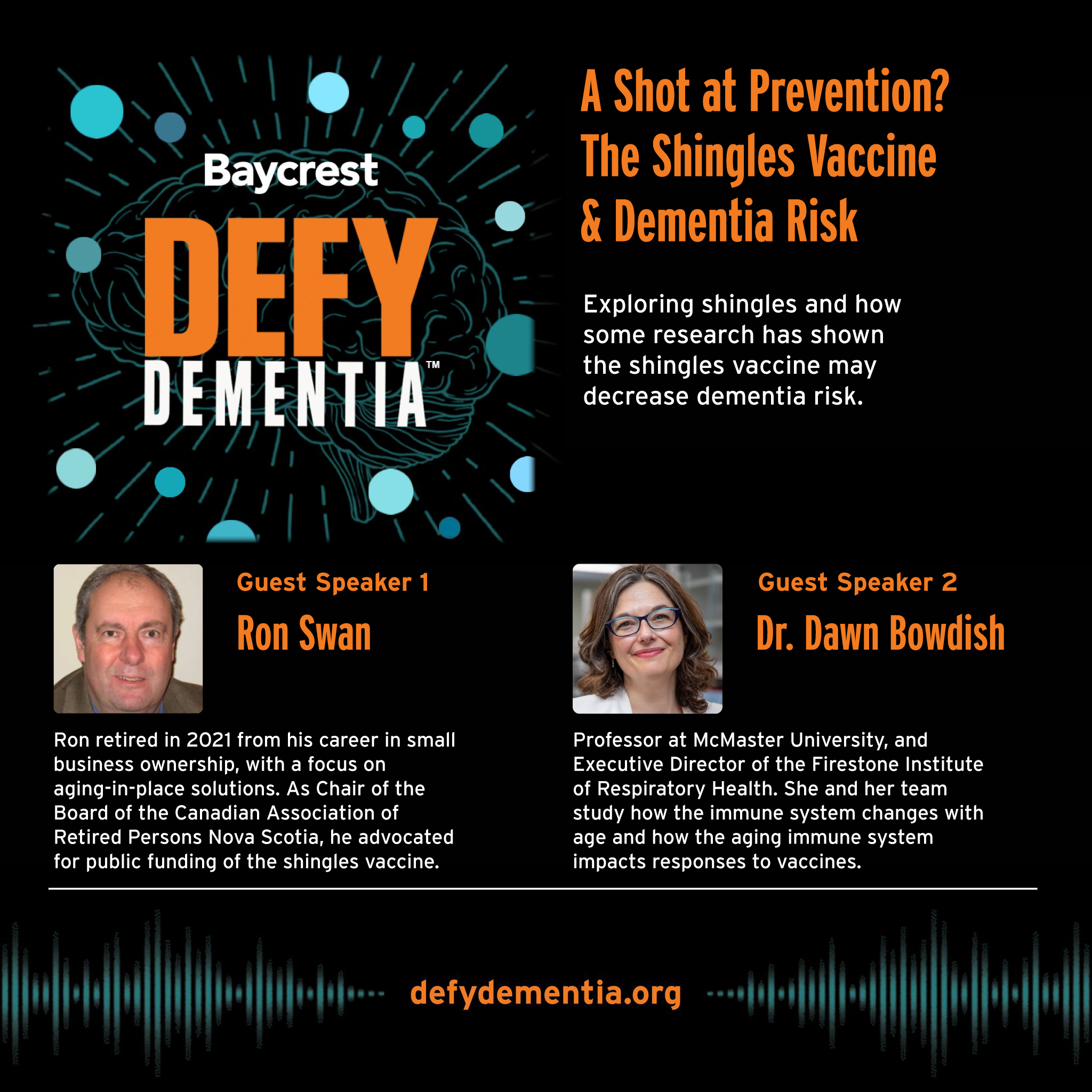
Dr Bowdish speaks on Defy Dementia™ Episode 35: A Shot at Prevention? The Shingles Vaccine & Dementia Risk

Listen to the epidsode here.

Could a routine vaccine help protect your brain? In this episode, we explore emerging research on the association between shingles vaccination and reduced dementia risk. Ron Swan shares his perspective as a community advocate focused on aging and accessibility, while Dr. Dawn Bowdish (Professor, McMaster University) breaks down what the science says, and what it doesn’t, about how vaccines may influence brain health. Together, they unpack what shingles is and what “promising but early” research about shingles vaccination could mean for reducing dementia risk.

Tune in at defydementia.org, or wherever you get your podcasts.

Web resources

Link between shingles vaccine and slowed dementia is ‘promising’ says expert – from Harvard School of Public Health


For those living with dementia, new study suggests shingles vaccine could slow the disease – from Standford Medicine


‘Strong evidence’ of lowered dementia risk: the benefits of shingles vaccination – from The Guardian


Can a routine vaccine prevent dementia? – from Harvard Health Publishing, Harvard Medical School


Is dementia a vaccine preventable condition? – from Bowdish Lab, Macrophage Biology at McMaster University


Guests:

Ron Swan
Ron Swan is a retired business development professional and entrepreneur with a strong focus on accessibility and aging-in-place. He founded Home Safe Living, a company that provided independent living and accessibility solutions across the Maritime region before selling the business to Lawton’s Drugs, a Sobeys company.


A passionate advocate for older adults, Ron continues to contribute through leadership roles, including Chair of the Board of CARP Nova Scotia and past Chair of the Seniors’ Advisory Council of Nova Scotia. He is frequently called upon to speak on aging, accessibility and community well-being.


Dr. Dawn Bowdish
Dr. Bowdish is a Professor at McMaster University and Executive Director of the Firestone Institute of Respiratory Health. Her research focuses on how aging affects the immune system, particularly how inflammation alters immune cell function and increases susceptibility to infections.Her work also examines how the aging immune system interacts with the microbiome and how these processes influence healthy and unhealthy aging. Dr. Bowdish leads the Preclinical Studies in Aging Laboratory and serves on the Board of Directors of the Lung Health Foundation, where she advocates for improved lung health and research funding for older adults.


Dr. Bowdish discusses measles elimination on TVO’s ‘The Rundown’

In 1998, Canada celebrated a huge milestone. We became one of the first countries in the world to eliminate measles. Twenty-seven years later, things are dramatically different. That’s because one year ago in New Brunswick, measles made a reappearance. What started as one case quickly spread across the country. And has continued to spread for a full year. Pay attention to that one-year mark, because it’s important. According to public health, if the chain of transmission can’t be broken in a year, it means a country can no longer call itself measles-free. Canada’s status will officially be determined at a meeting next month. We have had outbreaks since 1998, but we’ve always been able to break the chain of transmission. But not this time. Spread has been slowing. But it’s still making headlines. Like possible exposures this month in Ottawa. And Alberta recently reported its first measles death since the outbreak began. So—how did we get here? And what would it take to make measles a disease of the past. Again?

Dr. Bowdish is a panelist at the National Vaccine Summit on Adult Vaccination.

Over the past 50 years, immunizations have saved more lives in Canada than any other health intervention. With the help of a doctor, an immunologist, a pharmacist and a patient advocate, Zoomer Radio’s Liz West leads this discussion about vaccines – what’s available, where and why we need them.
National Vaccine Summit
‣ Recommended Vaccines & How To Get Them
‣ Navigating Provincial Health Systems
‣ The Role Your Pharmacist Can Play
‣ Emerging Science
‣ Fighting Disinformation & Vaccine Fatigue

Publication: “Rationalizing recommendations for influenza and COVID-19 vaccines”

Rationalizing recommendations for influenza and COVID-19 vaccines
Jessica A. Breznik, Matthew S. Miller, Dawn M.E. Bowdish
Article 127775

Supplementary Tables and references

Bluesky Explainer here.

I’m excited to share our review “Rationalizing recommendations for influenza and COVID-19 vaccines”, which we feel makes a strong case for universal influenza and COVID-19 vaccination policies. With almost 500 references & 8 supplementary tables it’s a beast so let me break it down for you….1/n

https://www.sciencedirect.com/science/article/pii/S0264410X25010722#ec0005

We started this >a year ago after conversations with immunologists, policy-makers, and the general public. We felt there were misunderstandings about how well COVID-19 vaccines work. We argue that they work as well or better than influenza vaccines so vaccination policies should be similar. 2/n

Like influenza, everyone but newborns has been exposed to COVID-19 through either vaccination or infection so we only reviewed studies in the post-Omicron/post-vaccine era. There is no doubt that the burden of disease has changed in the Omicron/vaccine era, but does that mean COVID is over? 3/n

Comparable data is hard to find, but when we looked at 2022/23 & 2023/24 data we see that deaths are still higher for COVID than influenza BUT looking at % hides the fact that COVID-19 is more contagious and in 23/24 there were almost 3x as many COVID hospitalizations than influenza. 4/n

There’s a common belief that COVID-19 vaccines don’t provide very good protection against symptomatic infection -is this true? These data are very, very hard to compile because the pace of variant replacement and vaccine changes has been dizzying 5/n

Before we get to the data – I just want to give a huge shoutout to @belongia.bsky.social for leading so many high quality studies on influenza effectiveness – look how easy to compare year-to-year. 6/n

Now look at how complicated it is to compare COVID-19 vaccine effectiveness. In influenza studies it is often possible to assess which strain a person was infected with so you can assess vaccine effectiveness by strain. COVID-19 vaccines are almost never matched with the circulating variants.. 7/n

…but despite that disadvantage, levels of protection from symptomatic infection and severe disease are similar between COVID & influenza vaccines. Note that protection against symptomatic infection is VERY hard to estimate because people who don’t get sick don’t get tested. 8/n

There has been some frustration that COVID-19 vaccines don’t last longer but neither does protection from either infection or vaccination for other viruses. When we compare protection < 3 months and > 3 months, COVID-19 vaccines look pretty good, esp considering rapid variant change 9/n

We also make a case to increase to increase the range of vulnerable populations. Canada has been a leader in including congregate living and equity-deserving groups in priority populations (#elbowsup !) but people living with lung and heart issues should be included 10/n.

Vaccine programs are decided by more than efficacy and efficacy – here’s a summary of what the National Advisory Council on Immunization (Canada) includes. Our review doesn’t address the programmatic, cost, and social considerations, which are also important. 11/n

There are still a lot of unknowns, but we feel strongly that universal & free COVID-19 and influenza vaccines would be a good investment in health, health systems, and attendance at work and school. Thank you to the brilliantly detail oriented Dr.@jabreznik.bsky.social and infl Dr Matt Miller Fin!

Dr. Bowdish’s “The Perils of Being Born in the Fall” is playing at the Toronto Fringe Festival, July 2-12th

Born in September? This professor has got bad news for you. Spend an hour of edu-tainment touring through the wackiness of early 19th century psychiatry, stealth mid-century reproductive rights activism, the climate/pregnancy connection, and learn why cold & flu season has an outsize impact on mental health. Didn’t think science could be funny? Come check out the only show in this year’s Fringe put on by a PhD scientist – you might laugh, but you’ll definitely learn. Tickets are “Pay What You Can” and available for as little as $4! Suitable for ages 13+ (PG). Content warning: brief mention of suicidality, mentions of mental health, abortion and reproductive sex.

Show times are:

2nd July 5:00pm
4th July 8:15pm
5th July 1:00pm
7th July 4:45pm
8th July 2:30pm
10th July 4:15pm
12th July 10:15pm

Helen Gardiner Phelan Playhouse
79 St George St, Toronto, ON M5S 3L8

For details and tickets: https://fringetoronto.com/fringe/show/perils-being-born-fall

CBC’s Quirks and Quarks ‘Scientific Sovereignty — How Canadian scientists are coping with U.S. cuts and chaos’ featuring Dr. Bowdish and MD/PhD candidate Kevin Zhao

June 20, 2025

Politically-driven chaos is disrupting U.S. scientific institutions and creating challenges for science in Canada. Science is a global endeavour and collaborations with the U.S. are routine. In this special episode of Quirks & Quarks, we explore what Canadian scientists are doing to preserve their work to assert scientific sovereignty in the face of this unprecedented destabilization. 


Canadian climate scientists brace for cuts to climate science infrastructure and data 
U.S. President Donald Trump’s attacks on climate science are putting our Earth observing systems, in the oceans and in orbit, at risk. Canadian scientists who rely on U.S. led climate data infrastructure worry about losing long-term data that would affect our ability to understand our changing climate. With: 
Kate Moran, the president and CEO of Ocean Networks Canada and Emeritus Professor of Oceanography at the University of Victoria 
Debra Wunch, Physicist at the University of Toronto
Chris Fletcher, Department of Geography and Environmental Management at the University of Waterloo


U.S. cuts to Great Lakes science and monitoring threaten our shared freshwater resource
U.S. budget and staffing cuts are jeopardizing the long-standing collaboration with our southern neighbour to maintain the health of the Great Lakes, our shared resource and the largest freshwater system in the world. 
With: 
Jérôme Marty, executive director of the International Association for Great Lakes Research and part-time professor at the University of Ottawa
Greg McClinchey, policy and legislative director with the Great Lakes Fishery Commission
Michael Wilkie, Biologist at Wilfred Laurier University
Brittney Borowiec, research associate in the Wilkie Lab at Wilfred Laurier University
Aaron Fisk, Ecologist and Canada Research Chair at the University of Windsor


Unexpected ways U.S. culture war policies are affecting Canadian scientists 
One of the first things President Trump did after taking office was to sign an executive order eliminating all DEI policies in the federal government. This is having far-reaching consequences for Canadian scientists as they navigate the new reality of our frequent research partner’s hostility against so-called “woke science.”
With:
Dr. Sofia Ahmed, Clinician scientist, and academic lead for the Women and Children’s Health Research Institute at the University of Alberta 
Angela Kaida, professor of health sciences and Canada Research Chair at Simon Fraser University in Vancouver
Dawn Bowdish, professor of immunology, the executive director of the Firestone Institute for Respiratory Health and Canada Research Chair at McMaster University
Kevin Zhao, MD/PhD student in immunology in the Bowdish Lab at McMaster University
(starting at 36:10)
Jérôme Marty, executive director of the International Association for Great Lakes Research


Canada has a ‘responsibility’ to step up and assert scientific sovereignty
A 2023 report on how to strengthen our federal research support system could be our roadmap to more robust scientific sovereignty. The Advisory Panel on the Federal Research Support System made recommendations to the federal government for how we could reform our funding landscape. The intent was to allow us to quickly respond to national research priorities and to make Canada a more enticing research partner in world science. 
With: 
Frédéric Bouchard, Dean of the Faculty of Arts and Sciences and professor of philosophy of science at the Université de Montreal. Chair of the Advisory Panel on the Federal Research Support System.