Unfortunately the lab is full and we cannot take any more students or volunteers for the 2025/26 academic year. Best of luck with your search.
The Bowdish lab is not accepting undergraduate or graduate students for 2025/2026
Reply

Unfortunately the lab is full and we cannot take any more students or volunteers for the 2025/26 academic year. Best of luck with your search.
Supplementary Tables and references
Bluesky Explainer here.
I’m excited to share our review “Rationalizing recommendations for influenza and COVID-19 vaccines”, which we feel makes a strong case for universal influenza and COVID-19 vaccination policies. With almost 500 references & 8 supplementary tables it’s a beast so let me break it down for you….1/n
https://www.sciencedirect.com/science/article/pii/S0264410X25010722#ec0005
We started this >a year ago after conversations with immunologists, policy-makers, and the general public. We felt there were misunderstandings about how well COVID-19 vaccines work. We argue that they work as well or better than influenza vaccines so vaccination policies should be similar. 2/n
Like influenza, everyone but newborns has been exposed to COVID-19 through either vaccination or infection so we only reviewed studies in the post-Omicron/post-vaccine era. There is no doubt that the burden of disease has changed in the Omicron/vaccine era, but does that mean COVID is over? 3/n
Comparable data is hard to find, but when we looked at 2022/23 & 2023/24 data we see that deaths are still higher for COVID than influenza BUT looking at % hides the fact that COVID-19 is more contagious and in 23/24 there were almost 3x as many COVID hospitalizations than influenza. 4/n
There’s a common belief that COVID-19 vaccines don’t provide very good protection against symptomatic infection -is this true? These data are very, very hard to compile because the pace of variant replacement and vaccine changes has been dizzying 5/n
Before we get to the data – I just want to give a huge shoutout to @belongia.bsky.social for leading so many high quality studies on influenza effectiveness – look how easy to compare year-to-year. 6/n
Now look at how complicated it is to compare COVID-19 vaccine effectiveness. In influenza studies it is often possible to assess which strain a person was infected with so you can assess vaccine effectiveness by strain. COVID-19 vaccines are almost never matched with the circulating variants.. 7/n
…but despite that disadvantage, levels of protection from symptomatic infection and severe disease are similar between COVID & influenza vaccines. Note that protection against symptomatic infection is VERY hard to estimate because people who don’t get sick don’t get tested. 8/n
There has been some frustration that COVID-19 vaccines don’t last longer but neither does protection from either infection or vaccination for other viruses. When we compare protection < 3 months and > 3 months, COVID-19 vaccines look pretty good, esp considering rapid variant change 9/n
We also make a case to increase to increase the range of vulnerable populations. Canada has been a leader in including congregate living and equity-deserving groups in priority populations (#elbowsup !) but people living with lung and heart issues should be included 10/n.
Vaccine programs are decided by more than efficacy and efficacy – here’s a summary of what the National Advisory Council on Immunization (Canada) includes. Our review doesn’t address the programmatic, cost, and social considerations, which are also important. 11/n
There are still a lot of unknowns, but we feel strongly that universal & free COVID-19 and influenza vaccines would be a good investment in health, health systems, and attendance at work and school. Thank you to the brilliantly detail oriented Dr.@jabreznik.bsky.social and infl Dr Matt Miller Fin!
Bluesky Explainer thread by Dr. Kate Kennedy here:
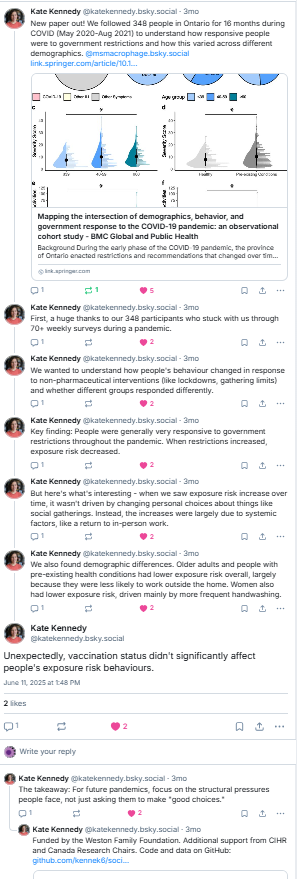
Below is an ‘explainer’ thread from Bluesky. See original here
Publication alert: “No evidence of immune exhaustion after repeated SARS-CoV-2 vaccination in vulnerable and healthy populations” @natcomms.nature.com The backstory is particularly interesting-it’s a tale of the conflicting needs of scientists & decision makers in times of disinformation ….1/n
To begin – my team was funded by the CITF to study COVID-19 infections/vaccinations in older adults & people on immunosuppressants. We had a broad mandate to look at ‘cellular & humoral immunity’ and unlike most grants there was a constant feedback to decision makers, participants & the public 2/n https://www.covid19immunitytaskforce.ca/
This meant that I got a pretty good sense of people’s worries and concerns and we could get solid data to address them. Case in point – we provided data that long-term care residents needed a 3rd dose and then a 4th – they got them and colleagues proved they prevented many infections 3/n https://www.bmj.com/content/378/bmj-2022-071502.short
In 2021 internet personalities were fretting that too many vaccines would lead to ‘immune exhaustion’. Most immunologists were not worried (explanation to follow) but I was shocked to hear in meetings that some folks on decision making tables were worried, esp, for vulnerable populations 4/n
What is this scary ‘immune exhaustion’? When you turn on an inflammatory response (e.g., by vaccination/infection) you have to have a way to turn it off. T cells that recognize an antigen multiply, make cytokines and start to express ‘off-switches’ which have names like PD-1, Tim-3 & Lag-3. 5/n
When there is a lot of antigen around (ie. during infection or vaccination) the balance between the on-switch (antigen-stimulation) and the off-switch (PD-1 & friends) favours being on – the T cells expand & differentiate & work their magic. Here PD1 is better described as an ‘activation marker’….. 6/n
…than an exhaustion marker. When the antigen decreases (ie infection or vaccine clears), the off-switches signal that it’s time to close up the inflammatory shop. It is pretty rare that antigens don’t go away but in cancer that chronic stimulation can lead to sustained expression of the PD1 off-switch. 7/n
How do you know when a T cell is truly ‘exhausted’? It expressed these markers AND it loses its function. Here’s where our study shines – we looked at the T cells’ ability to produce at least 1 cytokine (‘functionality’) or more than 1 cytokine (‘polyfunctionality’). 8/n
Repeat vaccination does not affect the T cells ability to make cytokines, even in vulnerable populations. They may express some activation markers but they are definitely not turned off. 9/n
Pity the lead author, PhD student @jennabenoit.bsky.social Her committee would grill her ‘why are you doing this- we all know vaccines don’t cause exhaustion!’ She held strong “Because policymakers & the public need us to PROVE this in THESE people”-She was strong, thorough & committed. 10/n
So why do so many people make such rash statements on whether a T cell is doing it’s thing (PD-1 = activation) vs crashing out (PD-1 =exhausted)? Above I said this disinformation began circulating in 2021 – we’ve been working on this story since then 11/n
Measuring 1 marker (eg PD1) and making wild inferences is relatively cheap & quick but measuring T cell function and analyzing these complex data is slow & expensive. Indeed we had a team of people working very hard in a clinical trials quality immune testing lab and an analysis team to generate these data. 12/n
https://healthresearch.healthsci.mcmaster.ca/single-cell-spatial-profiling-core-facility/human-immune-monitoring-services/
Learnings: Disinformation = quick to make up but hard to disprove and even immunologists and experts can have seeds of doubt sown by bad actors. Vulnerable populations deserve to be included in research. Negative data studies are impt but hard to sell (see reviews of the paper!). 13/n
Huge shout out to lead author @jennabenoit.bsky.social and the not-on-Bluesky team from our star phlebotomist/blood processor Braeden Cowbrough, flow cytometry genius Dr. Jessica Breznik, analytics guru Dr. Chris Verschoor, and HITS Team (Nichols, Hagerman, Bramson) and of course our participants. 14/14
Dr Bowdish’s solo storytelling/scicom presentation recives a 5N review from Next Magazine! Read the full review here: https://nextmag.ca/fringe-review-the-perils-of-being-born-in-the-fall-provides-laughter-tears-and-scientific-history/

Born in September? This professor has got bad news for you. Spend an hour of edu-tainment touring through the wackiness of early 19th century psychiatry, stealth mid-century reproductive rights activism, the climate/pregnancy connection, and learn why cold & flu season has an outsize impact on mental health. Didn’t think science could be funny? Come check out the only show in this year’s Fringe put on by a PhD scientist – you might laugh, but you’ll definitely learn. Tickets are “Pay What You Can” and available for as little as $4! Suitable for ages 13+ (PG). Content warning: brief mention of suicidality, mentions of mental health, abortion and reproductive sex.
Show times are:
2nd July 5:00pm
4th July 8:15pm
5th July 1:00pm
7th July 4:45pm
8th July 2:30pm
10th July 4:15pm
12th July 10:15pm
Helen Gardiner Phelan Playhouse
79 St George St, Toronto, ON M5S 3L8
For details and tickets: https://fringetoronto.com/fringe/show/perils-being-born-fall
Link to publication here.
Link to Bluesky “Skeetorial” here and reproduced below without images:
New paper! “Minimal Impact of Prior Common Cold Coronavirus Exposure on Immune Responses to Severe Acute Respiratory Syndrome Coronavirus 2 Vaccination or Infection Risk in Older Adults in Congregate Care”. For those of you who follow our #COVID work, read on for the story behind the story. 1/n
Remember reports like this one from the beginning of the pandemic? How could some older adults show such resilience to COVID compared to their peers? Some thought that they might have cross reactive immunity due to exposure to the related ‘seasonal’ or ‘common cold’ coronaviruses. 2/n
https://www.cbc.ca/news/canada/ottawa/102-year-old-woman-recovers-from-covid-19-1.5567189
After all, our @mcmasteru.bsky.social colleagues, Dr. Mark Loeb & team had shown years earlier that seasonal/common cold coronaviruses caused a lots of infections in long-term care and others had investigated whether these might protect kids from COVID…. 3/n
https://journals.plos.org/plosone/article?id=10.1371/journal.pone.0108481
….while others have shown that can be very deadly in residents of long-term care (reminding us that words matter and calling them ‘common colds’ minimizes risk – common viruses can still make people very sick, but that is rant for another day). So could pre-existing immunity be protective? 4/n
https://www.thelancet.com/journals/lanhl/article/PIIS2666-7568(23)00018-1/fulltext
Alternatively, maybe older adults got so sick because a life of exposure to these viruses ‘used up’ all the immune cells that could be used to respond to SARS-CoV-2 or COVID vaccines(i.e. ‘immune imprinting’, a phrase I came to hate along with ‘original antigenic sin’ as it was so misused) 5/n
To find out we tested whether antibody levels for the coronaviruses OC43, HL63, and 229E were higher/lower in people whose first COVID infection was an early Omicron variant and found they were not. Therefore it is unlikely these are either protective or problematic 6/n
What about pre-existing anti-coronavirus T cells? We looked at memory CD4+ and CD8+ T cells against the M & N proteins (indicates prev infections) and Spike (vaccine and infections). No evidence that these differed between those who did/did not get an infection (7/n)
What was a correlate of protection? Anti-RBD-IgG & neutralizing antibodies to the ancestral virus (which is all the residents would have been vaccinated to at that point). Unlike others we didn’t find that (serum) IgA was a correlate of protection. 8/n
Pre-existing immunity to common cold coronaviruses didn’t protect against SARS-CoV-2/COVID but might our vaccines and immunity alter immune responses to seasonal coronaviruses? Antibodies to other coronaviruses increased a bit (‘back-boosting’) after COVID infection or vaccination…. 9/n
But I doubt this will have much effect on the prevalence of other coronaviruses who follow a pretty consistent yearly/biennial or big wave/small wave pattern in the Northern hemisphere. We don’t know why but we do know that immunity doesn’t last long so a small boost from COVID infection/vaccination is not likely to make a difference 10/n
https://www.nature.com/articles/s41591-020-1083-1
Caveats: Only measured peoples first infections in the early Omicron era, only older adults living in LTC and retirement homes, vaccines would have been against the ancestral virus – things might be different in other populations/variants/vaccines. 11/n
Huge shout out to Braeden Cowborough for doing all those titres – that’s a lot of plates – and to Dr Jessica Breznik (former @miramcmaster.bsky.social currently @mcmasternexus.bsky.social PDF) for analytic skills. Thanks to the rest of the COVID-in-LTC team @mcmasteriidr.bsky.social
The Bowdish lab has received funding from the Canadian Institute for Health Research (CIHR) to study immune responses to SARS-CoV-2 infections and vaccinations in older adults including those living in long-term care. The applicant will use over 10,000 biobanked saliva, PBMCs, and serum from over 500 participants in addition to participant metadata and detailed infection records to;
The successful applicant will have significant leeway to develop an independent research project based on their interests and expertise. The applicant will work closely with an experienced technician and a graduate student, external collaborators, and will have access to biostatistics expertise. If interested, there will be opportunities to teach undergraduate courses.
The initial
contract will be for one year, with the possibility of extending for more
years, depending on productivity. The position is funded, but the applicant
will also apply for internal and external funding sources.
The Bowdish Lab is situated at Canada’s most research-intensive university, McMaster University in Hamilton, Ontario Canada. We are a diverse group of undergraduate students, graduate students, technicians and post-doctoral fellows committed to uncovering how the aging immune system changes and understanding why this alters immune responses to vaccination and respiratory infection. For more details on our lab’s philosophy see https://www.bowdish.ca/lab/lab-philosophy/ . We emphasize teamwork, career development, and leadership. Many of our former PDFs have gone on to independent faculty positions in Canada and abroad.
| Must have;Passion for discovery & evidence of leadership in the form of first-author publications in a relevant field.Team-player with history of collaboration and mentorshipFlow cytometry experienceDeep knowledge of immunity | Nice to have;Experience in human immunology/vaccinologyExperience in antibody quantitation and functional antibody assays (e.g., ADCC, ADP)Experience in intracellular cytokine staining or Experience in science communication with vulnerable populations. |
Please send Dr. Bowdish (bowdish@mcmaster.ca);